


Unveiling RAP1, LDM and the future of autonomous off-roading

We’ve been believers since driving the very first Rivian R1T on and off road in Colorado back in 2021. Since then we have tackled everything from breezy California road trips to dusty and demanding adventures out on the playa at Burning Man. The EVs themselves are already next-level, but what Rivian unveiled today at its inaugural Autonomy and AI Day proves they are dedicated not just to building great trucks and SUVs, but to defining the entire future of the AI-defined ownership experience.
Rivian showcased its roadmap toward global leadership in AI-defined vehicles, powered by a unique vertically-integrated strategy. CEO RJ Scaringe emphasized that this integration allows the company to invest in hardware and compute infrastructure, develop a self-improving end-to-end AI system and harness a shared data foundation across the business. This aggressive push is all aimed at the ultimate goal of achieving L4 autonomy, effectively giving customers their time back when in the car.
At the core of this seismic shift is Rivian’s transition to in-house purpose-built silicon chips. The company introduced its third-generation compute platform, the Gen 3 Autonomy Computer (ACM3), which represents a massive leap forward for developing advanced autonomy and physical AI.

The star of the show is the Rivian Autonomy Processor (RAP1), Rivian’s proprietary purpose-built 5nm custom silicon. RAP1 is a multi-chip module among the first of its kind used in high compute applications within the automotive industry. The ACM3 achieves a stunning performance and the benefits of this vertically-integrated system are clear: it provides engineering teams with higher power, meaningful cost savings and accelerated velocity. RAP1 uses RivLink a low-latency high-speed interconnect technology that allows multiple chips to connect and multiply processing power across a distributed system, making the platform inherently extensible. Engineered for functional safety, RAP1 also incorporates multiple layers of protection.

Rivian is putting AI at the center of the entire driving and ownership experience. Its Rivian Unified Intelligence (RUI) system blends data from the vehicle and the cloud to improve service, predict maintenance needs and unlock smarter features over time. The most visible example arrives in early 2026 with the Rivian Assistant, a next-generation voice interface for Gen 1 and Gen 2 R1 vehicles. Built on RUI and large language models, it can understand complex requests, reason through tasks and work seamlessly with third-party apps. You can ask it about your day, find your next stop or even reschedule a meeting while driving. In the R2, a more powerful infotainment computer lets the Assistant run fully offline for faster response and lower latency. RUI’s intelligence will also extend to service, scanning vehicle history and telemetry to help technicians diagnose issues and powering smarter self-service tools in the mobile app. Further, and perhaps most in demand, RUI enables an incredibly powerful messaging system that’s integrated with adjacent apps like search and mapping.
This AI foundation feeds into Rivian’s autonomy strategy. The company trains its Large Driving Model (LDM), a generative-AI based driving model, using a constant stream of real-world data that helps it learn how humans actually drive. The system improves as more vehicles join the fleet, refining the on-board driving models with strategies learned from this expanding knowledge base.

Rivian’s sensor suite today uses cameras and radar. Starting with the R2, the company will add LiDAR to provide more precise depth information and create a richer ground truth for training the LDM. This new hardware package, which includes Rivian’s third-generation autonomy computer, is in validation now and expected to ship on R2 vehicles at the end of 2026.
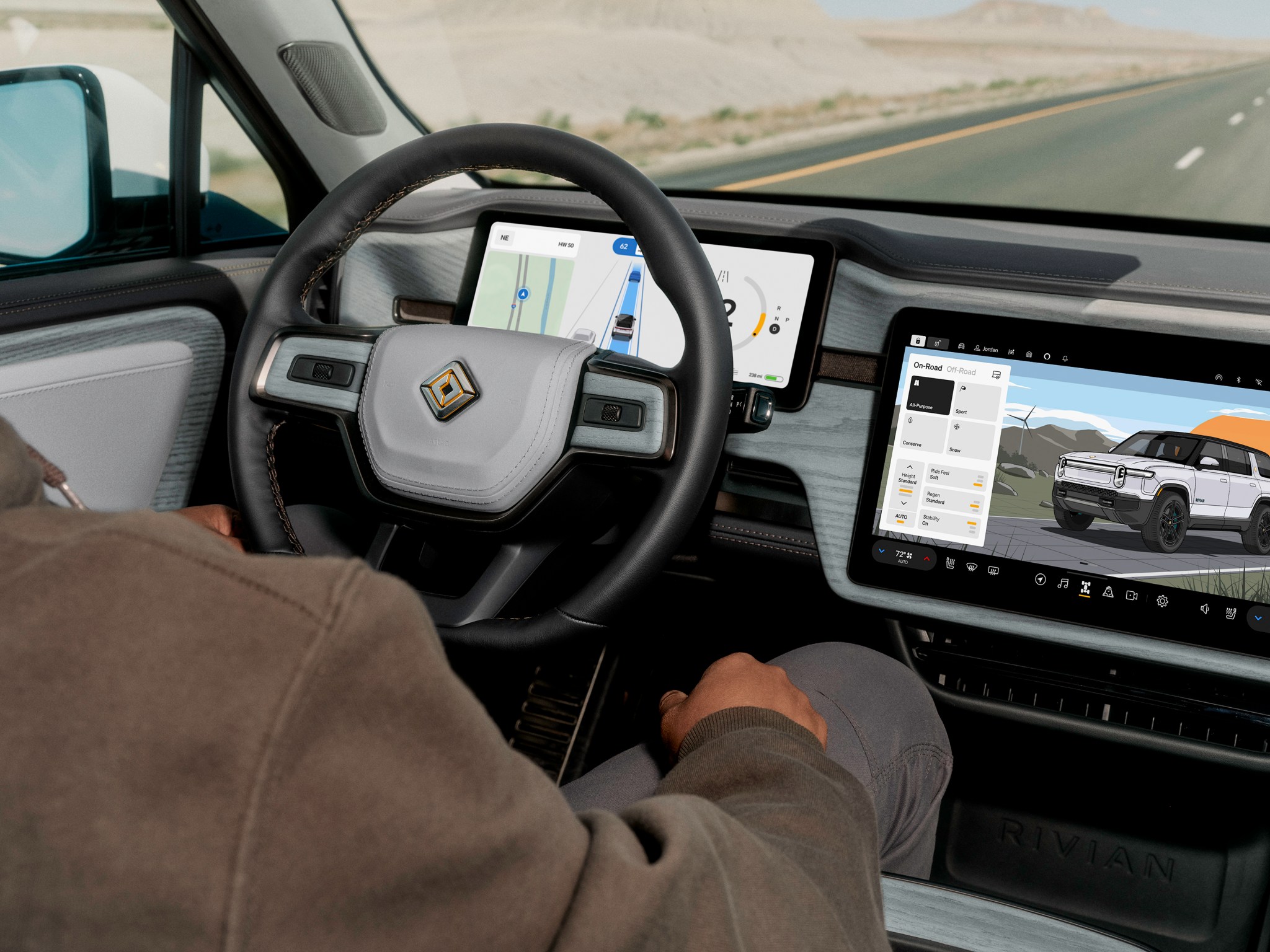
Progress is already reaching current owners. A coming software update will deliver Universal Hands-Free driving to Gen 2 R1 vehicles, covering more than 3.5 million miles of marked roads in the US and Canada, including many routes beyond major highways. Rivian will launch its autonomy subscription, Autonomy+, in early 2026 for a one-time $2,500 payment or $49.99 per month. The roadmap includes continual expansion of capabilities leading toward point-to-point eyes-off driving and personal Level 4 autonomy.
Rivian is not just building electric adventure vehicles; they are building foundational technologies that will help move the entire industry forward. This vertical integration allows the company to rapidly evolve the entire vehicle experience, marking an inflection point for integration and acceleration in their next stage of growth.
CONTEXT: incontent
This placeholder is removed when the ad slot is configured.
